
For an investor chasing rental yield, light taxation and a path to residency, Paraguay comes out ahead in 2026: price per m2 several times lower than Lisbon, territorial taxation capped at 10%, and permanent residency still open through a property investment. Portugal keeps the edge on liquidity, access to credit and European Union membership, but its two historic selling points, the real estate golden visa and the NHR tax regime, both disappeared between 2023 and 2024.
What changed in Portugal
Three recent shifts redraw the maths.
- The real estate golden visa was scrapped in October 2023 by the Mais Habitacao law. Other routes remain (investment funds in particular), but buying an apartment no longer grants any residence right.
- The NHR tax regime, which broadly exempted new foreign residents, has been closed to newcomers since 1 January 2024. Its replacement, the IFICI, targets specific profiles (research, innovation) and no longer covers the typical property investor.
- Prices, meanwhile, have not fallen: in Lisbon, property portals show 2026 asking prices of roughly 4,900 to 9,200 EUR per m2 (~5,400 to 10,100 USD) depending on the district, with a median around 6,600 EUR per m2 (~7,300 USD).
Portugal is still a fine market. But the equation that drew the international investor, residency plus taxation plus reasonable prices, no longer exists in that form.
What Paraguay offers in 2026
By contrast, Asuncion sits at a far earlier stage of its cycle: prices of roughly 1,500 to 2,500 USD per m2 (~1,350 to 2,250 EUR; in Paraguay, prices are quoted in dollars) depending on the area and standing, growth projected around 4.5% for 2026 (Central Bank of Paraguay) and an investment-grade rating confirmed by the main agencies.
Taxation is territorial: foreign-source income is not taxed, corporate tax is 10%, distributed dividends 8%, property tax 0.3 to 1% of the fiscal value, and there is neither wealth tax nor inheritance tax. The full figures are detailed in our Paraguay investment guide.
On residency, the Investor Pass introduced in April 2026 grants direct permanent residency from 200,000 USD (~182,000 EUR) invested in a commercial property intended for rental, an important nuance we explain in our residency through real estate investment guide.
The comparison, criterion by criterion
| Criterion | Paraguay (Asuncion) | Portugal (Lisbon) |
|---|---|---|
| Price per m2 | ~1,500 to 2,500 USD (~1,350 to 2,250 EUR) | ~4,900 to 9,200 EUR / ~5,400 to 10,100 USD (median ~6,600 EUR, 2026) |
| Entry ticket | Off-plan programmes from ~40,000 USD (~36,000 EUR) | Several hundred thousand euros in the capital |
| Investor taxation | Territorial: 0% on foreign income, 10% corporate tax | Progressive scale; NHR closed, IFICI restricted |
| Residency through property | Yes, Investor Pass from 200,000 USD | No, removed in October 2023 |
| Target net rental yield | 5 to 7% (long term), 8 to 10% (short term), per our models | Squeezed by high entry prices |
| Non-resident bank loan | No; interest-free staged developer financing | Yes, from local banks |
| Liquidity and market depth | Emerging market, thinner liquidity | Mature, highly liquid market |
| Currency zone | USD and guarani, outside the EU | Euro, European Union |
Where Portugal keeps the edge
Let us be honest, that is also what makes the comparison useful. Portugal offers a deep market where you resell quickly, bank credit accessible to non-residents that enables real leverage, the legal security of the European Union and a strong currency. If your priority is liquidity in euros and the ability to exit fast, Portugal remains a coherent choice, at the cost of a thinner yield.
Where Paraguay changes the game
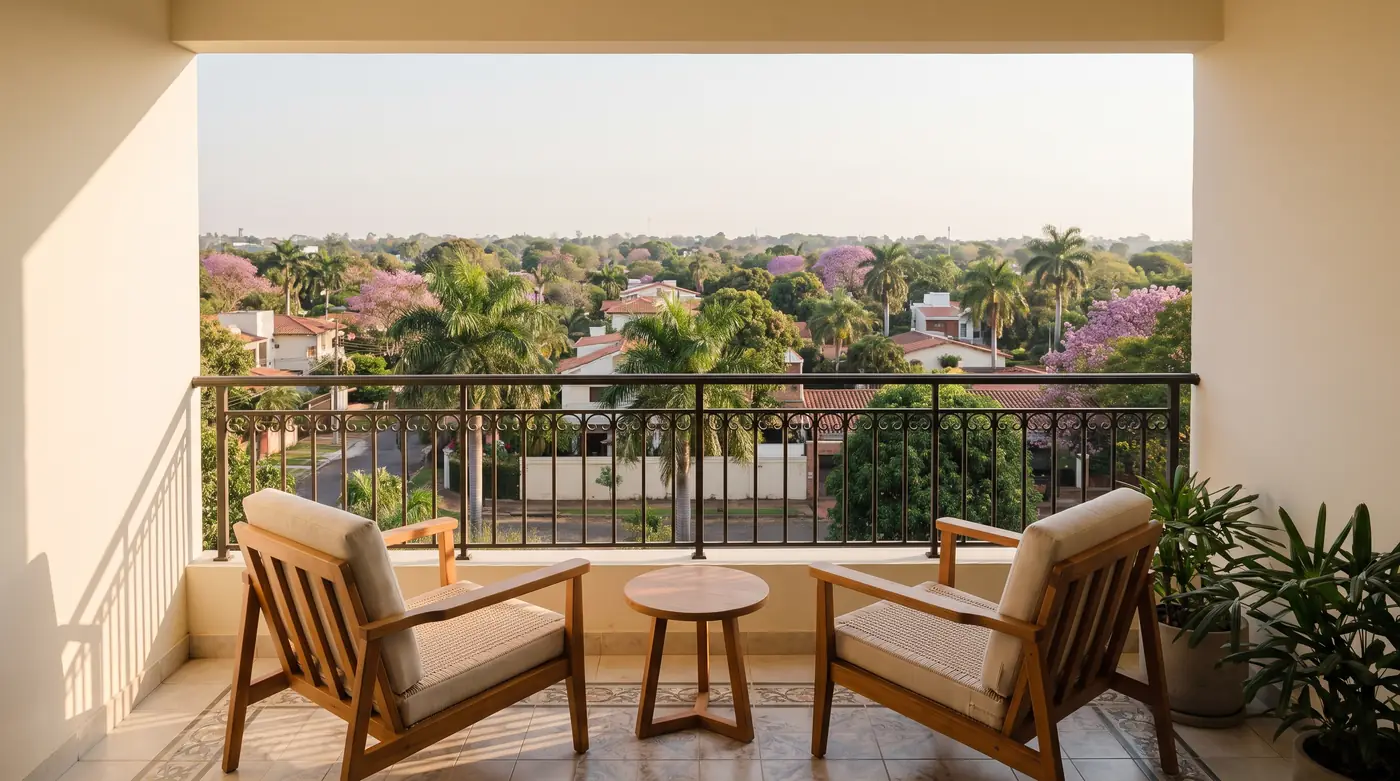
Paraguay plays a different tune: entering early in a market whose prices have not caught up with neighbouring capitals, collecting rent under a 10% tax regime, and spreading payment through interest-free developer financing rather than a bank loan. The absence of leverage is offset by a low entry ticket: you buy smaller, but you keep your cash and your yield.
Our stance is openly stated: we are an agency specialised in Paraguay, and this comparison reflects our clients' criteria (yield, taxation, residency). Weigh it against your own priorities.
FAQ
Can you still get a residence permit in Portugal by buying a property?
No. The real estate route of the Portuguese golden visa was removed in October 2023. In Paraguay, the Investor Pass grants direct permanent residency from 200,000 USD (~182,000 EUR) invested in a commercial property intended for rental.
What budget do you need to start?
In Lisbon, the 2026 median is around 6,600 EUR per m2 (~7,300 USD): a one-bedroom quickly runs into hundreds of thousands of euros. In Asuncion, off-plan programmes start around 40,000 USD (~36,000 EUR) with payment staged during construction.
Can a non-resident borrow?
In Portugal, yes: local banks finance non-residents. In Paraguay, no, but developer financing plays a similar role: the price is paid in stages during construction, interest-free.
What is the main risk on the Paraguay side?
It is an emerging market: thinner liquidity on resale, reliance on the developer's quality for new builds, less abundant market data than in Europe. These risks are managed through the selection of projects and developers, not through ignorance.
Let's talk about your project
The right choice depends on your horizon, your personal tax situation and your need for liquidity. If the Paraguayan profile matches your criteria, let's talk: we are an English-speaking team based in Asuncion, and we will hand you a costed simulation on a real property, fully transparent about the risks.
This article is provided for general information and does not constitute investment or tax advice. Portugal sources: Mais Habitacao law (October 2023), Portuguese state budget 2024 (NHR closure to newcomers), public property portals (2026 data). Paraguay side: BCP, DNIT, MOA data and models detailed in our investment guide. Check your situation with a tax adviser before any decision.